
Seeing how this has affected the jobs and livelihood of many of my friends and family, I decided to focus on how COVID-19 may change things going forward within the workplace, as this seems to be the part of day to day life that this pandemic has affected the most. The general consensus of many sites following the research I did seemed to be that the main thing experts are expecting to change is the workplace environment. This makes sense, as many companies now see that it is much easier to utilize remote methods of conferencing and completing projects than they had previously thought. Companies will start to see all of the benefits that could come from doing work remotely. “The chief financial officer will tell her CEO about how much money will be saved by ditching pricey New York City offices and allowing employees to work at home” (Kelly, 2020). Some suggest that office space/buildings may even become a status symbol among companies. Jane Oates, a former assistant secretary at the Department of Labor, says that having office space could even become a way for companies to recruit talent. “Job seekers may consider it a draw to work for a company with a physical location, which could boost brand awareness and overall influence within the industry” (Classicalycourt, 2020).
This pandemic has also changed what we see as essential work. Some jobs that are now essential-have always been seen that way, like doctors, nurses, and sanitation workers. But some jobs were not. Like delivery drivers, or 16-year-old minimum wage supermarket employees. Some suggest that this may lead to more young people studying trades as opposed to going to a traditional university as a result of seeing their parents struggle through COVID-19. This period in history has given us a deeper understanding of what work is really needed in an emergency and what isn’t. “The pandemic is highlighting that many jobs are not essential, yet we lack sufficient key workers to respond when things go bad” (BBC Future, 2020). In the future, this may lead to the improvement of working conditions for those workers and an increase in the minimum wage.
Something else I hadn’t thought of before is how things may change for women in the workplace going forward in a positive way. Women in a professional career are often expected to give all of their time to their careers and to their families. This is often called “the second shift”. Women are also discriminated against in the workplace when it comes to pregnancy and having children. Some experts have said that companies seeing how easy remote business is, could lead to improved attitudes towards women who wish to start families in the professional field. “According to Elise Gould, senior economist at the Economic Policy Institute, these policies could have a positive benefit on working women, allowing them to “make a schedule around the other responsibilities they have”” (Classicalycourt, 2020). As a woman, who one day hopes to have a career and family, hearing that in the future companies may start to be more understanding of women wanting to start families, it makes me happy to hear that things may be changing for the better for women in the workplace in the future. There is also the potential for this to become the case for many workers, not just working women with families. Another suggestion for changes that may occur at all levels of employment in the workplace is a shortening of the workweek and allowing employees to work at a slower pace under less pressure from upper management. According to Adam Grant, a professor at the Wharton School, there will certainly be positive changes for employees going forward from this. “We’re going to see a lot of employers embrace more flexibility around working from home and having virtual teams” (Chainey, 2020).
While this all feels very overwhelming, and it seems that most new sites and sources are pointing to the worst of the worst. We also have to keep in mind, these are just predictions. We truly don’t know what’s to come following this pandemic, but that doesn’t mean that it’s going to be all bad. As with anything, there will be positives and there will be negatives. But I am sure that we will bounce back just as we always have. And we may even end up somewhere better than where we left off.
- Brianna O’Doherty
Sources:
Classicalycourt. “13 Ways the Coronavirus Pandemic Could Forever Change the Way We Work.” CNBC, CNBC, 30 Apr. 2020, www.cnbc.com/2020/04/29/how-the-coronavirus-pandemic-will-impact-the-future-of-work.html.
Classicalycourt. “Why Long-Term Flexible Work Options Could Be a Game Changer for Women.” CNBC, CNBC, 29 Apr. 2020, www.cnbc.com/2020/04/29/why-long-term-flexible-work-options-could-be-a-game-changer-for-women.html.
“How Will Coronavirus Change the World?” BBC Future, BBC, 31 Mar. 2020, www.bbc.com/future/article/20200331-covid-19-how-will-the-coronavirus-change-the-world.
Chainey, Ross, and Digital Media Specialist. “This Is How COVID-19 Could Change the World of Work for Good.” World Economic Forum, www.weforum.org/agenda/2020/04/here-s-how-coronavirus-has-changed-the-world-of-work-covid19-adam-grant/.
Kelly, Jack. “How The Coronavirus Outbreak Will Change Careers And Lives For The Foreseeable Future.” Forbes, Forbes Magazine, 9 Apr. 2020, www.forbes.com/sites/jackkelly/2020/04/09/the-aftermath-of-covid-19-will-cause-alarming-changes-to-our-careers-and-lives/.
Mull, Story by Amanda. “Generation C Has Nowhere to Turn.” The Atlantic, Atlantic Media Company, 22 Apr. 2020, www.theatlantic.com/health/archive/2020/04/how-coronavirus-will-change-young-peoples-lives/609862/.
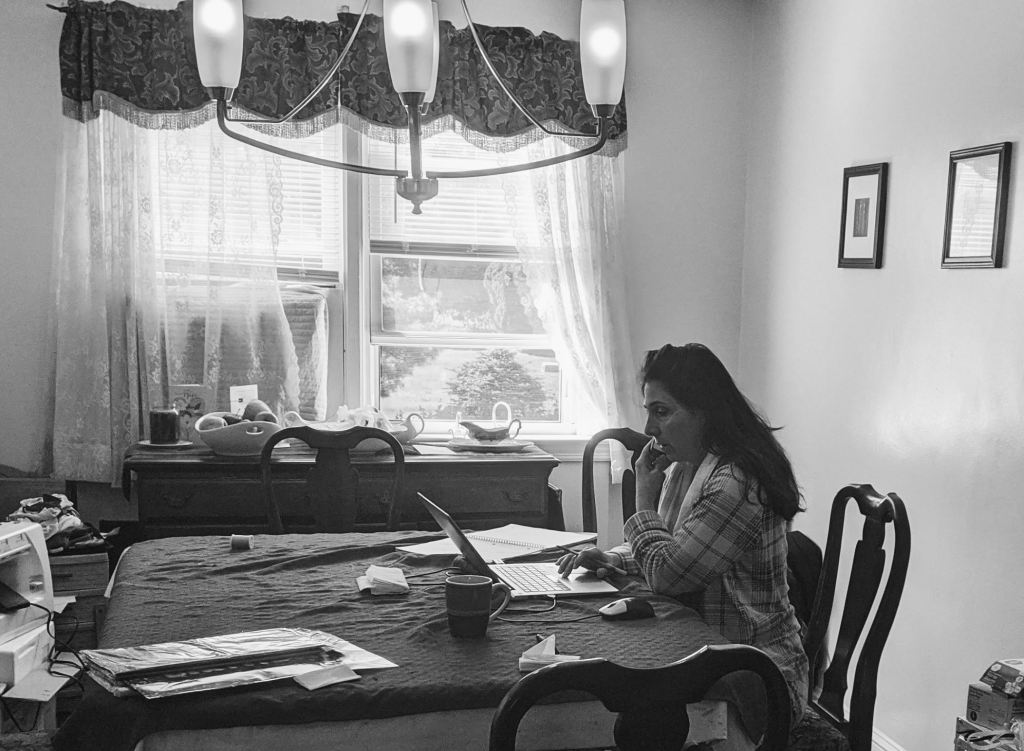
photo: My mother hard at work in her new office, our dining room.
 ENGL110 Spring 2020 11:15-12:05
I hadn’t thought of the impact this will have on women in the workforce but your third paragraph drew a lot of great points that I was able to grasp and relate to by seeing my mom work at home now. The company she works for was considered essential since it is in the pet industry and has to provide products to the growing amount of pet owners. The company is considering going remote at least for some of the week. This eliminates the 1-hour drive to work and back and able to cook breakfast and dinner. You addressed this in your paper and I bet more mothers and companies will be open to the idea of working remotely with children, a positive to this horrible virus. I also like how you wrapped it all up looking at things positively in the last paragraph, I think many need to focus on how this is temporary and the world may even be better after some years of rebuilding.
-Miguel Palacios
LikeLike
I really liked how you talked about essential vs non essential work. Like when you said “Some suggest that this may lead to more young people studying trades as opposed to going to a traditional university as a result of seeing their parents struggle through COVID-19”. I find this to be very true and a good sign. Many people spend hundreds of thousands of dollars to get them a useless degree that will barely make them ends meet in the future, let alone during a pandemic. This might motivate people to get jobs that require more hands on expertise, not just academic qualifications. I also liked how you talked about the more family friendly environment for women in the work place. People should be encouraged to start families, not see it as a burden.
-Mihalis Hrisafinis
LikeLike
I enjoyed reading your writing as it focuses on the effects of the Coronavirus on the workforce. The part about essential workers not all being ones that require a college degree shows how versatile our country really is. I especially like how you showed how the effect on the workforce could possibly change our generations views on jobs. I also enjoyed how you took some positive away from the situation. Businesses are becoming more accepting of woman which is a positive to take away from such a terrible event.
– Tommy Wilcox
LikeLike